Saint Lawrence the Martyr Roman Catholic Church
GPS Coordinates: 38.7820349, -77.1535978
Closest Address: 6222 Franconia Road, Alexandria, VA 22310
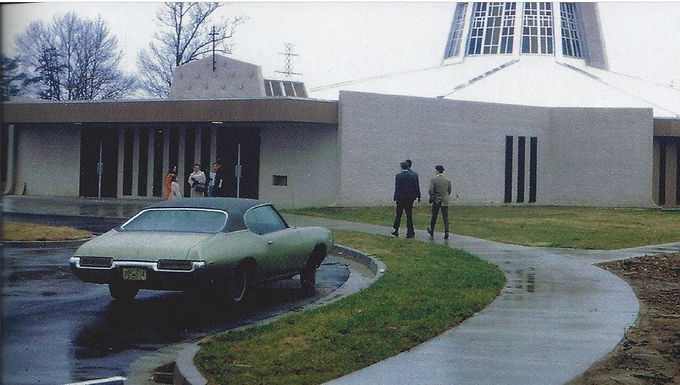
Here follows an excerpt from the Catholic Diocese of Arlington’s newspaper, the Arlington Catholic Herald:
Richmond Bishop John J. Russell established the parish in 1967. At that time, Mass was celebrated at Edison High School, less than 2 miles away from its current location. Msg. Frank E. Mahler, was the first pastor. The church was built in Alexandria in 1970.
In 1977, the 10 anniversary Mass was celebrated by Arlington Bishop Thomas J. Welsh and celebrated its 50 year anniversary on Saturday, May 20, 2017 with a Mass celebrated by The Most Reverend Michael F. Burbidge and Msg. Frank E. Mahler, founding pastor of St. Lawrence, was the homilist.
<•>•<•>•<•>•<•>•<•>•<•>•<•>•<•>•<•>•<•>
<•>•<•>•<•>•<•>•<•>•<•>•<•>•<•>•<•>•<•>
Here follows an excerpt from the church's website:
History of the Parish
On June 3, 1967, John J. Russell, Bishop of Richmond, established St Lawrence Parish in Franconia, VA. Father Frank E. Mahler was appointed founding pastor, and the 500 families who formed the original parish met at Edison High School to celebrate Mass until the church facility was constructed.
Bishop Russell dedicated the Church building, the Parish Hall and the Rectory/Office on December 12, 1970. In 1974, St Lawrence was one of 52 parishes that was formed into the new Diocese of Arlington under the leadership of the Most Reverend Thomas J. Welsh, first Bishop of Arlington.
In 1988, the Rose Garden was begun with Stations of the Cross, Divine Mercy Icon and a Memorial to the Unborn among other statues and memorials. On May 20, 2017, the garden was named in honor of Fr. McAfee in recognition of his extensive work in the expansion of the garden. This parish and all of those who visit our Fr McAfee Garden are grateful for all of his efforts to make it beautiful for future parishioners and visitors.
Pastors who have served at St Lawrence Parish are:
Father Frank E. Mahler 1967-1972
Father Austin L. Ryder 1972-1979
Father Henry E. Hammond 1979-1988
Father Franklyn M. McAfee 1988-1997
Father William J. Erbacher 1997-2001
Father Terrance R. Staples (Administrator) 2001-2002
Father Christopher Mould 2002-2015
Father Ronald J. Gripshover 2015- Present
Parishioners of St. Lawrence who answered the call to a vocation in Religious life:
Deacon Gerald A. Melvin -- Parishioner 1967-1986. Ordained a permanent deacon 6/18/78. His ordination was at St. Lawrence. He died on 5/17/04.
Deacon Joseph L. Bosch -- Parishioner from 1967 – 2000. Ordained a permanent deacon on 6/16/81. He died on 3/9/2002.
Fr. Stanley Bosch -- Parishioner 1967- 1986. Ordained to the Missionary Servants of the Most Holy Trinity on 6/07/86.
Deacon Walter E. Claassen, Jr. -- Parishioner 1982-1999. Ordained a permanent deacon 5/13/89. He died on 7/26/99.
Sr. Maria Grace Dateno, F.S.P. -- Parishioner from her Baptism on March 10, 1968 to 1984. She made her Perpetual Profession of Vows on 6/25/95.
Fr. Paul A. Berghout, J.C.L. -- Parishioner 1990-1992. He wa s ordained to the Holy Priesthood on 5/18/96 for the Diocese of Arlington.
Sr. Michelle Marie Kelly, S.N.D. -- Parishioner 1975-1989. She made her Final Profession of Vows in July 1998.
Sr. Ann Hyacinth Genow, O.P. (Name at birth: Leslie Ann Genow) -- She was received into the church at St. Lawrence in April 1992 and Professed her Final Vows in August 2001.
Sr. Mary Celeste D’Souza, O.P. -- She professed her Final Vows in 2001.
Fr. Ramon A. Baez -- Parishioner 1999-2005. He was ordained to the Holy Priesthood on 6/11/05 for the Diocese of Arlington.
Sr. Marie Celine Laird, O.P. (Name at birth: Brandee Marella Laird) -- Parishioner 1991-1998. She professed her Final Vows on 8/08/2005.
Fr. Scott A. Haynes -- Parishioner 1996-2000. He was ordained to the Holy Priesthood on 5/31/2007 for the Order Regular of Saint John Cantius.
Fr. Anthony J. Killian -- Parishioner 1992-2008. He w as ordained to the Holy Priesthood on 6/14/2008 for the Diocese of Arlington.
Fr. Robert J. Wagner -- Parishioner 2001-2003. He was ordained to the Holy Priesthood on 6/13/2009 for the Diocese of Arlington.
Sr. Cecillia Tsao (Name at birth: Cecillia Ching-Wen Tsao) -- Parishioner 2000 – 2003. She pronouncement her Vows on 8/22/2009.
Fr. Patrick Kokorian -- Parishioner 2000 – 2002. He was ordained to the Holy Priesthood at Most Holy Trinity Monastery in Petersham, Massachusetts on 10/27/13. He was elected second Abbot of the Monastery on 9/24/19.
Deacon Michael A. Waters -- Parishioner 1999 to Present. He was ordained a permanent deacon 1/17/2015 for the Diocese of Arlington.
Fr. Steven Oetjen -- Parishioner 1988 – 2017. He was ordained to the Holy Priesthood on 6/10/2017 for the Diocese of Arlington.
<•>•<•>•<•>•<•>•<•>•<•>•<•>•<•>•<•>•<•>
<•>•<•>•<•>•<•>•<•>•<•>•<•>•<•>•<•>•<•>
St. Lawrence the Martyr Bio
“My soul clings to you my God, because I endured death by fire for your sake.”
–Lauds Antiphon for St. Lawrence
St. Lawrence was one of the seven deacons of Rome; he was born in 225 in Huesca, Spain and suffered martyrdom in Rome during Emperor Valerian’s persecution of the Christians.
According to several early Christian writers, among them St. Ambrose and Prudentius, Lawrence was appointed deacon of Rome by Pope Sixtus II in 257, a position of great trust that included the care of the treasury and riches of the Church and the distribution of alms to the indigent. Lawrence was overwhelmed with grief when Pope Sixtus was condemned to death in 258. However, when Sixtus predicted he would follow him in three days, he was overjoyed and sold many of the Church’s possessions and donated the money to the poor.
When the Prefect of Rome heard of his action, he had Lawrence brought before him and demanded all the Church’s treasures be turned over to the Emperor. Lawrence said he would need three days to collect them and then he presented the blind, the crippled, the poor, the orphans and other unfortunates to the Prefect and told him they were the Church’s treasures.
Furious, the Prefect prepared a red hot griddle and bound Lawrence to it; Lawrence bore the agony with unbelievable equanimity and in the midst of his torment instructed the executioner to turn him over, as he was broiled enough on one side. From this derives his patronage of cooks, chefs, and comedians.
According to Prudentius, his death and example led to the conversion of Rome and signaled the end of paganism in the city. There is no doubt that his death inspired a great devotion in Rome, which quickly spread throughout the Church.
Prayer to St. Lawrence:
O glorious Saint Lawrence, Martyr and Deacon, who, being subjected to the most bitter torments, did not lose thy faith nor thy constancy in confessing Jesus Christ, obtain in like manner for us such an active and solid faith, that we shall never be ashamed to be true followers of Jesus Christ, and fervent Christians in word and in deed. Amen.
Died August 10, 258 AD
FEAST DAY – AUGUST 10
<•>•<•>•<•>•<•>•<•>•<•>•<•>•<•>•<•>•<•>
<•>•<•>•<•>•<•>•<•>•<•>•<•>•<•>•<•>•<•>
The Sacred Art of Saint Lawrence Catholic Church & Grounds
Saint Lawrence Catholic Church is in the Franconia neighborhood of Fairfax County, just east of Springfield, Virginia. His Excellency John J. Russell, Bishop of Richmond, established Saint Lawrence as a new parish in the Diocese of Richmond on June 3, 1967.
At first, Mass was offered at the nearby Thomas Edison High School until Bishop Russell dedicated the church, the parish hall, and the rectory on December 12, 1970. In 1974, Saint Lawrence became one of 52 parishes in the newly formed Diocese of Arlington under the leadership of the Most Reverend Thomas J. Welsh.
The original church building has been renovated several times. The most significant renovation to the interior was in the 1980s and 1990s when the entire sanctuary was redesigned and a communion rail was installed. In 2019 and 2020, a new Narthex and plaza was constructed to add much-needed space, and new Confessionals, a new Baptistry, and expanded restrooms were added.
Good and holy religious art is meant to draw the heart, mind, soul, and body to our Divine Creator as we see elements of His beauty in the art and architecture. We pray that the many religious symbols, statues, and art in St. Lawrence Catholic Church and grounds will inspire and deepen your faith and help bring your soul closer to the infinite beauty that is our Almighty God!
I. The Church Courtyard
On the sidewalk area approaching the main entrances of the church are 14 stones, reminding us of the contributions of the Apostles and Evangelists. The Four Evangelists—the writers of the Gospels—are represented on the corners of the courtyard (stones 2, 7, 10, and 15); the other stones are the Apostles.
1. First and foremost in the center of the courtyard is the wonderful and large statue of the Sacred Heart of Jesus. As our Lord and Savior hung on the cross, His glorious side was stabbed open by a Roman soldier’s lance and from this holy wound flowed water and His Precious Blood as His Sacred Heart was pierced (John 19:31-34). Now His Heart is open to all who seek refuge in the Second Person of the Blessed Trinity.
2. St. Matthew, Apostle & Evangelist, symbolized with an angel (or a man). Associating symbols with the Four Evangelists dates to at least St. Irenaeus (c. 203), who interpreted the four creatures in the Book of Revelation (4:7) as the Four Evangelists. Because St. Matthew opens his Gospel with Jesus’ genealogy from Abraham, he is assigned the symbol of an angel or man. This beautifully represents our Lord’s Incarnation and His Human Nature.
3. St. Phillip, Apostle, with symbols of a cross and bread. Phillip was present at the miracle of the loaves and fishes. According to tradition, he preached in Greece and was crucified upside-down.
4. St. James the Lesser, Apostle, with the symbol of a handsaw. James is listed in the Gospels as one of the “brothers,” that is, cousins, of the Lord and is the son of Alphaeus. His symbol of the handsaw hearkens to his family’s trade of carpentry.
5. St. Jude, Apostle, with the symbol of a boat. Jude authored an Epistle in his name and is known as the Patron Saint of the impossible.
6. St. Simon, Apostle, with the symbol of a fish. He is known as the Zealot for his zeal, first for Jewish law and
then, after his conversion, for Jesus Christ.
7. St. Mark, Apostle & Evangelist, with the symbol of a winged lion because his Gospel begins with the voice crying in the wilderness that roars like a lion.
8. St. Matthias, Apostle, with the symbol of a double-headed axe. Matthias was chosen by lot to replace Judas Iscariot as one of the 12 Apostles after Pentecost because he was “a witness with us to His [i.e., Jesus’] Resurrection” (Acts 1:22).
9. St. Thomas, Apostle, with the symbols of a scroll and square ruler. He is famously called “Doubting Thomas,” but he also shows fierce loyalty to Our Lord in the Gospels, particularly after Our Lord’s resurrection. He was martyred while preaching in India.
10. St. Luke, Evangelist, with the symbol of an ox. St. Luke is the author of the third Gospel and the Acts of the Apostles. The symbol of the ox is used as a figure of sacrifice, which opens St. Luke’s Gospel with the duties of Zachariah in the temple.
11. St. Bartholomew, Apostle, with flaying knives. Tradition informs us that he evangelized in India and suffered the particularly gruesome martyrdom of being flayed alive and then beheaded.
12. St. Andrew, Apostle, with an X-shaped cross, which teaches us how he gave glory to God by his martyrdom. St. Andrew was a follower of St. John the Baptist before following Jesus. He later introduced Simon Peter to Jesus.
13. St. Peter, Apostle & First Pope, shown with the symbol of keys, reminding us that our Lord Jesus gave “the keys to the Kingdom of Heaven” to Peter, symbolizing papal authority (Matthew 16:19). St. Peter suffered martyrdom with crucifixion on an upside-down cross because he did not believe himself worthy to die like our Savior.
14. St. James the Greater, Apostle, with the symbol of seashells. James is one of the three Apostles close to Jesus, along with his brother John. They are the sons of Zebedee and are sometimes called “Sons of Thunder” (Mark 3:17). The shells signify his work as a fisherman as well as for Baptism.
15. St. John, Apostle & Evangelist, with the symbol of an eagle. The eagle represents the elevated nature of St. John’s writings (his Gospel, his letters, and the Book of Revelation), which soar to lofty heights of contemplation of God and His Mysteries.
16. This statue of the Patron Saint of our parish, St. Lawrence the Martyr, was installed in 2022. Ancient tradition teaches us that he was martyred in 258 during the persecution of the Roman Emperor Valerian. The method of his martyrdom was to be grilled alive, thus in this statue he holds a gridiron.
17. This statue of St. Stephen, the first Martyr of the Church, was also added in 2022. He was a deacon in the early church. His defense of his faith enraged members of various synagogues and he was stoned to death outside Jerusalem.
II. The Narthex
In 2019 and 2020, the new Narthex and entrance plaza were designed and constructed. The entrance to a church is called a Narthex, meaning “porch” or “lobby.” In the early Church, this area was used by those who could not enter the main worship area but who still wanted to hear the sermon. The Narthex is the gathering place separate from the main church where silence and quiet should be maintained for the edification of worship and prayer.
Narthex stained glass windows 1 through 6, running along the back of the Baptistry to the left of the entrance doors, carry themes of family and the Sacrament of Baptism.
1. St. Joseph & the Child Jesus. St. Joseph was a carpenter and the foster father of Jesus. He obeyed God faithfully and quietly. Tradition holds that he did not live to witness the public ministry of the Lord Jesus. Thus, it is believed that he had the Blessed Virgin Mary and Jesus with him at his death, making St. Joseph the Patron Saint of a happy death. He is also the Patron Saint of the Universal Church and a model for all fathers.
2. St. John the Baptist is wearing a camel hair cloak, which he wore when preaching (Matthew 3:4; Mark 1:6). John Baptized Jesus in the Jordan River (Matthew 3:13 and following (ff), Mark 1:9ff; Luke 3:21ff). John was later imprisoned after denouncing the improper marriage of Herodias and was then beheaded at the request of Salome, daughter of Herodias (Matthew 14; Mark 6).
3. Christ & Young Child. Our Lord taught His followers that to enter Heaven, we must be innocent, pure, simple, and tender like children: “Truly I tell you, unless you change and become like children, you will never enter the Kingdom of Heaven” (Matthew 18:3).
4. St. Anne & Mary. St. Anne, the mother of Mary, Our Lady. St. Anne and her husband St. Joachim were said to be barren for many years before the miracle of the Immaculate Conception. The Church rightly honors the parents of Our Lady, as they trained her who is “full of grace.”
5. St. Stephen is the first Martyr of the Church. His witness to the faith and his subsequent martyrdom are recorded in the Acts of the Apostles, Chapters 6 & 7. As a deacon of the Church, he is seen here holding a thurible for incensing.
6. Guardian Angel & Young Girl. As Psalm 91 says, “He has given His angels charge over you, to keep you in all your ways” (Psalms 91:11). Thus, Holy Church teaches that every person has a Guardian Angel to help us on our journey of holiness.
7. Another statue of the Patron Saint of this parish, St. Lawrence the Martyr, stands in the Narthex. The palm branch he holds symbolizes that he was victorious in his suffering for Jesus Christ. He is dressed in the vestments of a deacon: an alb and a dalmatic.
8. The two middle entrance doors feature beautifully etched glass images of the Sacred Heart and the two side glass doors feature the etched image of the Immaculate Heart. The Crown of Thorns on the Sacred Heart reminds us of our Lord’s suffering by His Crowning of Thorns (Matthew 27:29; Mark 15:17; John 19:2). The sword piercing Our Lady’s Immaculate Heart is the fulfillment of Simeon’s prophecy that she would suffer with her Divine Son: “…and you yourself a sword will pierce so that the thoughts of many hearts may be revealed” (Luke 23:35).
Narthex stained glass windows 9 through 14, to the right of the entrance doors, carry themes of Christ’s victory and Divine Kingship.
9. The Resurrection. Christ’s Resurrection gives us hope that death is not the end, but that we too will be glorified with Christ on the last day.
10. Our Lady of Victory. This title of Our Lady recalls the decisive victory over the Muslims at the naval battle at Lepanto (October 7, 1571), before which Pope Pius V asked the whole Church to invoke Our Lady’s help and protection by praying the Rosary. As such it is a popular name for churches and chapels at naval bases. October 7 is now the Feast of Our Lady of the Rosary.
11. St. Kevin. The Irish are famous in the early Church for their monks and missionaries. St. Kevin was a monk and abbot of Glendalough, where he lived and prayed in a tower. He died on June 3, 618.
12. The Blessed Sacrament. Jesus in the Blessed Sacrament is the “source and summit of the Christian faith” (Lumen Gentium 11). Jesus’ Real Presence abides with us in the Tabernacle, where He always waits for us to visit Him.
13. Jesus King of All Nations. Sacred Scripture acknowledges God’s universal dominion, and Jesus has received a kingship from God the Father, which never ceases but extends to all the ends of the Earth. Holy Church celebrates Christ the King on the Sunday before the First Sunday of Advent.
14. Our Lady of the Railways. This depiction shows us one of the many ways Our Blessed Mother aids us in connecting our spiritual and physical world. In the late 1950s, Richard Cardinal Cushing, the Cardinal Archbishop of Boston, established a chapel dedicated to Our Lady of the Railways in the Boston South Station Rail Terminal to help make worship more convenient for workers. The St. Lawrence Church campus is located on property that was once a part of the old Franconia Station on the adjacent railway lines. These rail lines, which now also include tracks for Metro, are still active today.
III. The Baptistry
The Baptistry is on the left side as one enters the church. This area is used only for the celebration of the Sacrament of Baptism. In this small area are several points of interest and symbolism.
The Baptistry Railing is adorned with glass etchings that draw us into the celebration and meaning of the initial Sacrament of the faithful and how God used water as a symbol of Baptism in the Old Testament. From left to right, the etchings depict:
1. Symbols of Salvation. A dove and a rainbow are the symbols of salvation from the flood witnessed by Noah (Genesis 9:12-13; 8:8-12). The word “PAX” (peace) transitions the panel from the Old Testament to the New Testament with a cross surrounded by incense and a priest’s stole and hands. Below this we see “A” (Alpha) and “Ω” (Omega), the first and last letters of the Greek alphabet, then some Holy Oil (more on this in the final glass panel), and the Paschal Candle.
2. The next panel shows God creating the water (Genesis 1:6-10), Noah’s Ark (Genesis 7), and Moses parting the Red Sea (Exodus 14:21-22). Each of these depicts the significance of water in the Old Testament.
3. In the next panel, we see Moses striking a rock to give water to the thirsty Israelites as they journey in the desert (Numbers 20:11), Jesus preaching, and a priest baptizing a child. (Note the Godfather holding a lit Baptismal Candle.) Each of these shows the further spiritual significance of the restoration and new life brought about by water.
4. The final panel teaches the faithful about the three Holy Oils that are sometimes stored in the Ambry. Each of these oils is blessed by the bishop at the Chrism Mass, which is typically offered on Holy Thursday morning:
• The Oil of Catechumens is blessed, pure, olive oil. It is used only in the Sacrament of Baptism, which is symbolized in this panel by the shell pouring out water. A Catechumen is an unbaptized person making the journey of faith into the Church through religious instruction.
• The Oil of Chrism is used in Baptism, Confirmation, and Holy Orders. It is olive oil mixed with balsam (perfume). A Bishop spreads this oil generously over a new altar to consecrate it and anoints the walls of a new church with it to consecrate it for sacred use.
• The Oil of the Sick is blessed, pure, olive oil. A priest uses this oil to anoint the hands and forehead of the sick during the Sacrament of Anointing of the Sick.
5. Inside the Baptistry, the primary feature is the Baptismal Font. It is over this font that souls are washed clean from original sin and can enter the door to access the other Sacraments of Holy Church (from the Catechism of the Catholic Church (CCC) 1213ff; 1262ff). We are told by our Lord Jesus that we must be “born of water and the spirit” to enter the Kingdom of God (John 3:5). Thus, water is necessary for the celebration of the Sacrament of Baptism. The blessing of water for the Sacrament of Baptism (which is wonderfully explained in the CCC, paragraphs 1217 to 1222), beautifully lays out how God used water in the Old Testament to prefigure the Sacrament of Baptism. On the lid of the Font are deer, recalling Psalm 42, verse 2: “As the deer longs for streams of water, so my soul longs for You, O God.”
6. Behind the Baptismal Font stands the Paschal Candle. This candle, sometimes called the Easter Candle, is lit for the first time every year at the beginning of the Easter Vigil Mass and symbolizes the Light of Christ, Who leads us to our salvation. During the Easter Vigil Mass, this candle dispels the darkness of the night, just as the Light of Christ dispels the darkness of sin. From this Paschal Candle, the newly Baptized receive their own Baptismal Candles, lit from the Paschal Candle, to remind them that they also have the Light of Christ in them after Baptism. The Paschal Candle is also placed next to the casket of the deceased at Funeral Masses. Thus, It—the Light of Christ—is present at the beginning and end of a soul’s journey of faith, please God, leading him or her to Heaven.
7. The Ambry, which can house the Sacred Oils, is on the left wall of the Baptistry.
8. This wall also features a wonderful statue of the Blessed Virgin Mary and her mother, St. Anne.
9. On the wall to the right, there is an icon of Jesus’s Baptism in the Jordan River by St. John the Baptist (Matthew 3:13ff; Mark 1:9ff; Luke 3:21). In this icon, the Holy Spirit is symbolized by the dove descending on the Lord Jesus as the Angels witness this event. This is a manifestation of Jesus as our Messiah and the Son of God (CCC, 535). Our Lord submitted Himself to the Baptism of St. John, intended for sinners, in order to “fulfill all righteousness” (Matthew 3:5). This is a manifestation of His self-emptying, which we must also imitate in our walk with Him (CCC 1224).
IV. The Nave
This is where the faithful gather to pray. On the left (south) side of The Nave are:
1. The Infant of Prague statue. In His left hand, the Infant Jesus holds a miniature globe topped by a cross, representing His Kingship over the world. His right hand is raised in blessing, with two fingers bent to reflect Christ’s Divine and Human Nature, and the other three fingers raised to symbolize the unity of the Trinity.
2. A triptych of Our Lady, Health of the Sick. A triptych is a work of art (usually a panel painting) divided in three sections or of three carved panels hinged together. This image is based on one found in a Franciscan Friary in western Pennsylvania entitled, “Mater Nostra Infirmatorum” (“Our Lady, Health of the Sick”). Our Lady presses Our Lord to her cheek while He holds her in a tender embrace. Our Lady’s eyes look upon us, modeling for us how to turn to Our Lord in all our needs. The image is further embellished by the presence of a scroll in His left hand, signifying that He is the Divine Word which is to be proclaimed, and recalling how Our Lord speaks words of healing to the sick, the blind, and the leper, whom He encounters in His public ministry. The centrality of the figures, the rich colors including the gold background, and the Greek abbreviation (i.e., the first and last letters of the Greek word) identifying Jesus Christ (IC XC) and the Mother of God (MP OV) are common features to iconography.
Next are the stained glass windows inside the Confessional on this side, which can also be seen from outside the church:
3. St. John Bosco (1815-1888), holding three juggling balls, as he was noted for his talent at entertaining. Known as Don Bosco, he was an Italian educator and is the Patron Saint of schoolchildren.
4. Christopher Columbus (1451-1506), holding a sextant and sword. His voyage to seek out the West Indies was funded by the Catholic crown of Spain and his unexpected discovery of the Americas resulted in great missionary activity by the Spanish throughout Central and South America.
5. St. Patrick (387-c.461) wearing Episcopal robes and holding a three-leaf clover and staff. He was ordained Bishop of and missionary to Ireland, where he firmly planted the Catholic Faith.
The Stations of the Cross, marked in Roman numerals in the diagram, run along the left wall between the stained glass windows, beginning at the left back corner with Station VII to the front with Station I. Continuing with stained glass windows and art outside of the Confessional we find:
6. St. Anthony of Padua (1195-1231), holding a lily. Also known as St. Anthony of Lisbon (his birthplace), St. Anthony is remembered as an outstanding preacher. He was a friar of the Franciscan Order. He is the Patron of the poor and is often invoked when seeking lost items.
7. St. Edith Stein (1891-1942), holding a red text and pendant of a star with a “P” inscribed on it. She was a German Jewish philosopher who converted to Catholicism and became a Discalced Carmelite nun. She is a Martyr, having died in Auschwitz, and she is one of six Co-Patron Saints of Europe.
8. St. Kateri Tekakwitha (1656-1680), holding a lily. Baptized as Catherine and informally known as Lily of the Mohawks, St. Kateri was the first Native American recognized by the Church as a Saint. She is a Patron of ecology and the environment.
9. St. Cecilia (early third century), holding a harp. This depiction is appropriately near the organ and seating area for our choir. St. Cecelia is the patroness of musicians and church music because, it is said, she sang to God as she was dying. She had been struck three times on the neck with a sword, she lived for three days, and asked the Pope to convert her home into a church. St. Cecilia is one of seven women, in addition to the Blessed Virgin, commemorated by name in the First Canon of the Mass.
10. St. Elizabeth of Hungary (1207-1231), holding a crown. St. Elizabeth was a princess and an early member of the Third Order of St. Francis, by which she is honored as its patroness. She is best known for the story of the “Miracle of the Roses,” which says that while she was taking bread to the poor in secret, she met her husband Ludwig. To stop suspicions that Elizabeth was stealing treasure from the castle, he asked her to reveal what was hidden under her cloak. Her cloak fell open and a vision of white and red roses was seen, proving her innocence and that God was protecting her efforts.
11. St. Benedict Joseph Labre (1748-1783). St. Benedict joined the Third Order of St. Francis and lived a life of poverty and pilgrimage. He was known as the “Saint of the Forty Hours” for his dedication to Eucharistic Adoration. He is also the Patron of unmarried men, the homeless, and the mentally ill.
12. St. Charles Lwanga (1860-1886) was a Ugandan convert to Catholicism who was martyred by being burned alive. When asked by a king if he was willing to keep his faith, he bravely answered, “Until death!” He is the Patron Saint of African Catholic Youth Action.
13. The glass in the doors on this side show two symbols for Our Lord Jesus, which are properly viewed from the outside. One door features the first three letters of the name of Jesus in Greek, “IHS.” The other door features the first two Greek letters (but three letters in English) for Christ: Chi (X) and Rho (P), with Chi overlapping Rho. These are some of the earliest symbols used by the Church in its art when portraying Our Lord.
14. St. Michael the Archangel is not a Saint, but rather an Angel, the leader of all Angels and the Army of God. Scripture and tradition tell us he has four main responsibilities: to combat Satan; to escort the faithful to Heaven at their hour of death; to be a champion of all Christians and the Church itself; and to call men from life on Earth to their Heavenly judgment. Michael is mentioned explicitly in Revelation 12:7-12, where he does battle with Satan and casts him out of Heaven.
15. A statue of St. Benedict (480-543), with a raven taking bread and a book inscribed with “Asculta, O fili, praecepta magistri” (“Heed, my son, the precepts of the Master”). St. Benedict wrote his famous Rule of St. Benedict, which defined instructions for monastic life. The raven is with him in this statue because St. Benedict would regularly feed a raven from his portion of bread at mealtime. Once, a malicious person poisoned the bread Benedict was about to consume. Knowing the bread was tainted, St. Benedict called upon the raven to dispose of it and ensure no other being would be harmed. According to the story, the raven obeyed St. Benedict’s command and flew off with the poisoned bread.
16. The Holy Family banner shows us the beauty of the Holy Family of Jesus, Mary, and Joseph.
17. St. Therese of the Little Flower (or of Lisieux) (1873-1897), was born into a devout Catholic family in France. From an early age, she longed to become a Carmelite, even beseeching the Holy Father to grant her permission. She eventually was given permission to join and she advanced in holiness through her “Little Way.” She died at the age of 24 and quickly became well known throughout the Church as a powerful intercessor. Many people still pray Novenas to her, asking for a rose as a sign that their requests have been granted. She is the Patron Saint of florists, various illnesses, and missionaries.
Continuing along the wall of the church and along the side to the right of the Altar and Sanctuary, we encounter more statues and windows for the edification and devotion of the faithful, including the remainder of the Stations of the Cross, marked in Roman numerals on the diagram, in between the stained glass windows. Along the wall are:
18. A banner of St. Lawrence, the Patron of our church and parish.
19. Nearby also stands the statue of the Sacred Heart of Jesus. This image and title, matching the statue at the exterior front entrance of the church, reminds us of God’s boundless and passionate love for mankind.
20. A banner of Our Lady of Perpetual Help, in which the Child Jesus is held in the arms of the Madonna while angels surround them holding instruments of torture, foreshadowing our Savior’s death for our salvation. We pray the Novena to Our Lady of Perpetual Help every Monday evening here at St. Lawrence.
21. In the corner is a wonderful statue of The Pieta (“pity” or “compassion”). The pity and compassion of the Blessed Mother is captured as she holds the dead Body of her Son after His Crucifixion and Death. The most famous rendition of this is from the Renaissance artist Michelangelo, but it is not known whose work this one is. A replica of Michelangelo’s work is in the Father McAfee Garden.
22. St. Raphael the Archangel is one of only three Archangels named in the Bible. He is exclusively in the Old Testament Book of Tobit, where he first appears disguised in human form as the traveling companion of the younger Tobias. The story of their adventurous journey during which the protective influence of the Archangel is shown in many ways is picturesquely related in Tobit Chapters 5-11. After the return and the healing of the blindness of the elder Tobias, the Archangel makes himself known as “the angel Raphael, one of the seven who stands before the Lord (Tobit 12:15).
23. The two doors on this side feature stained-glass of the Greek letters Alpha (A) & Omega (Ω), which are the first and the last letters of the Greek alphabet. In the Book of Revelation, our Savior calls Himself, “the Alpha and the Omega” (1:8), “the Alpha and the Omega, the Beginning and the End” (21:6), and “the Alpha and the Omega, the First and the Last” (22:13).
24. Another depiction of our parish’s Patron Saint, St. Lawrence the Martyr, this time in stained glass.
25. Pope St. Sixtus II (d. 258) shown in white and holding the crozier of the Bishop of Rome. Sixtus II was Pope from 257 to 258. He was martyred under the Emperor Valerian during the same persecution that martyred St. Lawrence.
26. St. Maria Goretti (1890-1902) is shown in the red of a Martyr. She holds a lily indicating her purity. She is one of the youngest canonized Saints. Her father died when she was nine. She managed household duties while her mother, brothers, and sisters worked in the fields. While defending herself against the advances of a young man, she died at age 11. She is the Patron Saint of rape victims, teenage girls, modern youth, and victims of crime.
27. St. Anne, Mother of the Blessed Virgin Mary, is depicted with a scroll and Jewish star as she educates her daughter in the Jewish tradition.
28. St. Therese of the Child Jesus (1873-1897). See number 17 in the section about the Nave.
29. Blessed Margaret of Castello (1287-1320) shown here with a humped back and holding a rose. Margaret was born disfigured and blind and was abandoned by her parents in the parish church of the small village of Castello in Italy. She passed from family to family of the village until welcomed into the convent. Her joy was short-lived as the order was lax and eventually expelled her. She became a tertiary Dominican, cared for children while their parents worked, and is the Patron of unwanted children and the pro-life movement.
30. St. Francis of Assisi (1181 or 1182-1226) wearing the brown robe of the religious order he founded, the Franciscans. He is depicted here with the marks of Christ’s wounds (the Stigmata) on his hands and feet. Francis was born of a wealthy family but wanted to be a crusader. God intervened, asking him to return to Assisi and rebuild His Church. He lost his taste for earthy life and started an order of monks founded on the vow of poverty. He is the Patron Saint of animals, Italy, merchants, and stowaways.
The three stained glass windows inside the Confessional on this side are:
31. Venerable Matt Talbot (1856-1925) shown chained at the wrists. At a young age, Matt became an alcoholic and relied upon the graces of daily Mass to aid him in this affliction. He worked as a manual laborer and prayed the Rosary often. He died on his way to church on Trinity Sunday. He is the Patron of those who also struggle with alcoholism.
32. St. John Vianney (1786-1859), a French priest who is also known as the Curé of Ars, where he was pastor for many years and welcomed thousands of pilgrims a year. He would hear Confessions for hours each day. He was deeply devoted to the Holy Eucharist. He is the Patron Saint of parish priests.
33. St. Damien of Molokai (1840-1889), wearing a priest’s cassock and a necklace of flowers symbolizing his time in Molokai, Hawaii, where he ministered to lepers and was eventually afflicted with leprosy himself. Just past the Confessional, we continue with:
34. A statue of St. Anthony of Padua (1195-1231), holding the Child Jesus. St. Anthony was a Franciscan Friar known for his love of the poor and is venerated as the Patron Saint of lost things, lost people, and lost causes.
35. A statue of St. Martin de Porres (1579-1639), who was born to mixed-raced parents in Peru. He was admitted to a Dominican monastery as a lay-brother at a young age. During his many tasks in the monastery, he clung to God in his soul as he cared for the sick and established an orphanage and a hospital and other charitable institutions. He would also care for the miserable slaves who were brought to Peru. He is the Patron Saint of mixed-raced people and social justice.
V. The Altar & Sanctuary
The Altar & Sanctuary are separated from the Nave by the Altar Rail. This area contains several structures for Holy Mass and devotions, most notably the Altars and the Tabernacle.
1. The High Altar is along the wall of the Sanctuary and holds the Tabernacle, where the Blessed Sacrament is reserved for the faithful. Relics are reserved in the marble, but, unfortunately, it is not known what specific relics are reserved there.
2. The Crucifix above the High Altar reminds us of our Savior’s salvific sacrifice on the Cross, which is re-presented at each Holy Mass, which is sacrificial. The dove above the Crucifix represents the Holy Spirit. The letters above our Savior’s head, “INRI,” are an abbreviation for the Latin phrase “Iesus Nazarenus Rex Iudearum,” or “Jesus of Nazareth, King of the Jews.”
3. The Tabernacle houses the Real Presence of Our Lord. On its door are the images of the Four Evangelists: Matthew (angel or a man), Mark (lion), Luke (ox), and John (eagle). Two angels flank the Tabernacle as they do in Heaven, as the Angels constantly adore Our Lord in Heaven and in His Eucharistic Presence here on Earth, joined by the Church Militant (i.e., the Church on Earth).
4. The Sanctuary Lamp, the red tinted burning candle that hangs from the ceiling above the High Altar, is lit to remind us of Our Lord’s presence in the Tabernacle and that He is the Light of the World. When the faithful enter the church building and see this flame, they genuflect, lowering themselves on the right knee in the direction of the Tabernacle out of respect and reverence for the Eucharistic Presence of God.
5. Along the front of the Free-Standing Altar, on which Mass is most frequently offered (Mass can also be offered on the High Altar), is a depiction of Leonardo DaVinci’s Last Supper. Relics are also reserved in this Altar, though, as with the High Altar, it is not known whose relics are in the Free-Standing Altar.
6. Statue of the Blessed Virgin Mary. Her hands are extended to show the constant flow of grace she pours upon the world through her intercession, and with her feet she crushes the head of a serpent, recalling the word of God in Genesis that foretells that the woman will strike at the head of the serpent, while he strikes at her heel (Genesis 3:15).
7. Statue of St. Joseph, holding the Child Jesus. The lily at the top of the staff he holds symbolizes his great purity. The Child Jesus holds a globe with a cross on top, with His fingers raised in blessing.
8. Along the wall trim at the edges of the sanctuary are images of Grapes & 12 Sheaves of Wheat on each side. These represent the Twelve Tribes of Israel as well as the Twelve Apostles.
9. The Ambo stands near the front of the Sanctuary on Our Lady’s side. From here flow the proclamation of the Word of God from Sacred Scripture and the Homily.
10. The Flags of the United States of America & the Catholic Church are on either side of the sanctuary, indicating our allegiance to our Church and our country.
11. The Sacristy is behind the Sanctuary and is where the vestments for the priests, the Chalices, Ciboria, and other items for Mass and other Sacraments are kept.
The Grounds: Father McAfee Meditation Garden
Between the church and Hammond Hall is the Father McAfee Meditation Garden, dedicated to Fr. Franklin M. McAfee, pastor of St. Lawrence from 1988 to 1997. He laid out the original plans and plants for the garden along its gently curving path, which winds through various statues, the Stations of the Cross, devotions, and roses and many other plants. The Stations of the Cross in the Fr. McAfee Garden are marked with Roman numerals on the map.
1. Beginning at the Hammond Hall side of the Fr. McAfee Garden, the first path leads to a large statue of the Blessed Virgin Mary and her rose garden.
2. At the entrance of the Garden is a plaque dedicating the Garden to Fr. McAfee.
3. Across from the plaque is a wonderful Angel of God statue watching over the garden.
4. Here we find a statue of St. Fiacre, one of the Patron Saints of gardeners. Legend tells us that he was Irish but moved to France where he was a hermit who was visited by countless of the faithful for advice and the poor for charity. He died around 670.
5. Statue of Mary, the Queen of Heaven, wearing a royal crown. Pope Pius XII states in his encyclical “Ad Caeli Reginam” (1954) that Mary is Queen of Heaven because her Son is the King of Israel and the Heavenly King of the Universe. Sacred Scripture also speaks of the Queen of Heaven in Revelation Chapter 12.
6. Near the Statue of Our Lady, we find a statue of her husband, St. Joseph. He is presented to us with the tools of his trade.
7. The journey down the path next brings us to a statue of the Holy Family—Jesus, Mary, & Joseph. Together, they model for us how a truly holy family should operate: with love of God and love of neighbor (Matthew 22:34-40).
8. A statue of St. Anthony of Padua is next. Please see #6 and #34 in the Nave section of this booklet.
9. A statue of St. Francis of Assisi is just beyond St. Anthony’s Statue. Please refer to #30 in the Nave section.
10. At the next loop, we encounter another beautiful statue of the Blessed Virgin Mary. It is natural that she should be featured frequently because she is the greatest Saint and the most faithful follower of her Divine Son, Jesus Christ.
11. The Fountain in the garden is yet another reminder of the beauty of God’s use of water in salvation history, most poignantly in the Sacrament of Baptism. Divine Providence’s use of water is beautifully traced in the Blessing of water for the Sacrament of Baptism. This Blessing is explained in the CCC, paragraphs 1217 to 1222.
12. The statue of St. Pius of Pietrelcina (aka Padre Pio) (1887-1968) is between two sections of the main path along a walkway. St. Padre Pio was an Italian priest who was known for his great wisdom, humility, and piety. He spent many hours in the Confessional helping souls to know and love God more deeply.
13. Here we find a statue of the “Greatest Saint of Modern times,” St. Therese of the Little Flower. For information about her, please see #17 in the Nave section.
14. At this location is a large statue of St. Michael the Archangel, the champion of the battle in Revelations 12. Please see #14 in the Nave section.
15. Under the beautiful canopy is a replica of Michelangelo’s famous Pieta. The original of this masterful work of art is just inside the main doors of St. Peter’s Basilica in Rome. Please see #21 in the Nave section.
16. The Memorial Garden for Children is a special area of the Fr. McAfee Garden dedicated to children who died before or shortly after birth. Parents of such children can have a rock engraved with their child’s name or other meaningful things to help with the mourning of such a tragic loss. Please keep these parents and their children in your prayers.
17. Just across from the Memorial Garden is a small statue of the Sacred Heart of Jesus. Please refer to #1 in the Church Courtyard section.
18. Our Lord tells His disciples, “Let the children come to Me, and do not stop them, for it is to such as these that the Kingdom of Heaven belongs” (Matthew 19:14). This peaceful area reminds us of this and that we are called by our Savior, “Truly I tell you, unless you change and become like children, you will never enter the Kingdom of Heaven” (Matthew 18:3).
19. At the end of a long walkway — with roses on each side — we find a stunning image of The Divine Mercy. In 1931, our Lord Jesus appeared to Sister (now St.) Faustina Kowalska, a Polish nun. She saw Jesus clothed in a white garment with His right hand raised in blessing. His left hand was touching His garment in the area of the Heart, from which two large rays came forth, one red and the other pale. She gazed intently at the Lord in silence, her soul filled with awe, but also with great joy. Jesus said to her: “Paint an image according to the pattern you see, with the signature: ‘Jesus, I trust in You.’” Our Lord taught her that, “The two rays denote Blood and Water. The pale ray stands for the Water which makes souls righteous. The red ray stands for the Blood which is the life of souls. These two rays issued forth from the depths of My tender mercy when My agonized Heart was opened by a lance on the Cross. Happy is the one who will dwell in their shelter, for the just hand of God shall not lay hold of him. By means of this image I shall grant many graces to souls. It is to be a reminder of the demands of My mercy, because even the strongest faith is of no avail without works.” This image is now before you, offering you God’s mercy, particularly in the Sacrament of Confession.
20. Our beloved Fr. McAfee garden concludes with a statue of Our Lady of Fatima. From May to October 1917, the Blessed Virgin Mary appeared to three children — Lucia dos Santos, and Francisco and Jacinta Marto. This apparition of Our Lady is particularly marked by the “Miracle of the Sun,” in which the sun appeared to “dance” after a period of rain, the dark clouds broke, and the sun appeared as an opaque, spinning disc in the sky. It was said to be significantly duller than normal, and to cast multicolored lights across the landscape, the people, and the surrounding clouds. The sun was then reported to have careered towards the Earth before zig-zagging back to its normal position. Witnesses reported that their previously wet clothes became “suddenly and completely dry, as well as the wet and muddy ground that had been previously soaked because of the rain that had been falling.” Our Lady urges us to pray and make reparations for the conversion of sinners and to console Jesus.