Mount Vernon Presbyterian Church
GPS Coordinates: 38.7473795, -77.0643245
Closest Address: 2001 Sherwood Hall Lane, Alexandria, VA 22306
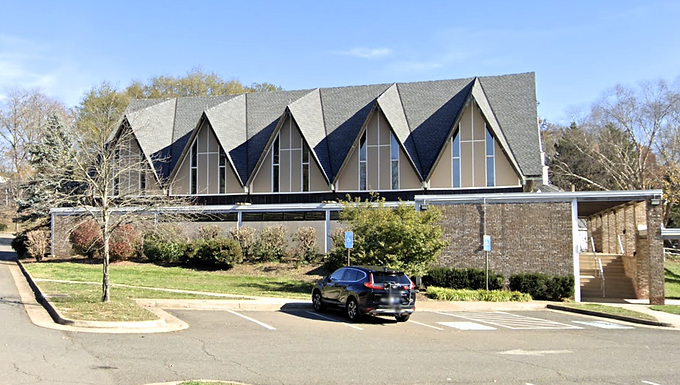
Here follows an excerpt from the church's website:
Our History
BORN IN A STABLE --
“BEING THE CHURCH”
TO SERVE A COMMUNITY
In 1953, Mount Vernon Presbyterian Church was founded. Its barn-like original sanctuary with an old white steeple has since been a familiar landmark about a third of a mile west of Fort Hunt Road on Sherwood Hall Lane. Few people today are aware of the impact in community service the young church had at its beginnings more than a half a century ago, or even its renewed commitment to helping those in need today.
Now, as a result of Be the Church Sunday on April 3, 2016, MVPC is rediscovering its roots. On that Sunday, after morning worship, 82 attendees branched out to volunteer at neighborhood centers for those ill or in need of assistance. Their service to others, ranged from a downtown homeless shelter in Washington, DC to the Mt. Vernon Inova Hospital, to a food pantry at United Community Ministries in our own neighborhood to the Eleanor Kennedy facility for homeless folks just south of Fort Belvoir on Route 1. A team in MVPC’s Fellowship Hall kitchen prepared 16 meals that were frozen and ready for distribution in the future to families in the church who might need emergency help.
MVPC pastor Bob Melone and the Church Session inspired this Sunday after Easter venture to focus the congregation on his recent sermon prescription familiar to service-oriented church communities in this post-millennial era: “Less creeds and more deeds.” Or, as former Mount Vernon Presbyterian interim minister Dick Neff described the legacy of the church: “Born in a stable to serve a community.” MVPC hopes such Be the Church events will continue in the months and years ahead.
Organized in 1952, dedicated in 1953, Mount Vernon Presbyterian has inspired several generations of helpers and church members who have aided the community since the founding years. An early project centered on Gum Springs, the celebrated home of descendants of George Washington’s slaves just three quarters of a mile west of MVPC on Sherwood Hall Lane. The needs then of Gum Springs inspired a spirit of community awareness and service that became a hallmark of Mount Vernon Presbyterian.
The church early on had joined other Presbyterian parishes to the north and south, and its oversight body insisted that it be centrally located near the then new homes of Hollin Hills on Accotink Road, as Sherwood Hall Lane was called at the time. One of today’s leaders of the church, Herb Lea, was four years old when Mount Vernon Presbyterian was founded and recalls that it was a dirt road. It was dotted with farms, including the dairy farm purchased for the church that had two barns and an artesian well.
The job foreman in converting the main barn to the first sanctuary for Mt. Vernon Presbyterian was church member Bob McLearen, a master construction specialist at the time. Kids enrolled in the first Vacation Bible Schools would walk down the lane toward Gum Springs to pet the animals at neighboring farms as a popular feature of special field trips in the summer.
According to the church historian, the late Howard Walker and author of Building a Living Edifice: the History of Mount Vernon Presbyterian Church, 1953-1993, the church members “could not wait to take over the property and immediately after its dedication they inspected the site. “Greeting them were two four-footed residents in the horse barn, one of who was roaming loose in the center aisle. After he was led into his stall, the church members climbed to the hayloft on the level above, which was to become the sanctuary. Up in the hayloft, parents of the toddlers had to restrain the curiosity of their young charges. In the center of the floor was a large hole through which hay for the horses was thrown down to the lower level, while at the end, where the door to the sanctuary would be located, was a large opening into which the hay was brought into the loft. ‘Mankind was never so happily inspired as when it made a cathedral,’ wrote Robert Louis Stevenson, to which the Mount Vernon folk could add when the modest church was christened, “even if it be built from a barn.”
Dedication day was February 1, 1953. According to historian Walker: “The weather that day was cold and especially windy in the barn hayloft, but the brief service of dedication led by Pastor Kirk Hammond was as warm, solemn and meaningful as any worship service could be. The inelegance of the barn became as grand as a cathedral. The bonding of fellowship and commitment in those few minutes became strong and irreplaceable. Truly, Christ’s presence was felt in this stable, too!”
Mike Dougherty, a present day Elder of Mount Vernon Presbyterian who graduated from communicants’ class with fellow teenager Herb Lea, recalls being in a Boy Scout troop that met at the church. Later, the old sanctuary in the upper level of the barn was used to shelter homeless families and singles during the first winter programs designed to help them. Several churches in the area joined together to make this pioneer program work. This helped encourage the county to establish what eventually became the Eleanor Kennedy Center for the homeless south of Ft. Belvoir on Route 1. MVPC longtime member Earl Flanagan, as a member of the Fairfax County Zoning Board, approved the conversion of this center from a Belvoir military structure to the homeless shelter it is today.
What was the secret of this young congregation? Mike Doherty’s mother, Maggie, was an important founding leader. “It was an exciting time,” she recalls. “The war was over and new families were moving into the neighborhood, wanting to build a community. We all had young children, and many people were willing to fill many jobs. There was lots of talent in that early church… we were young and enthusiastic about building a church and helping our neighbors.” When a contest was held to decide a name for the church newsletter, Maggie, now 91, won the prize with the title, The Stable-izer, in honor of the barn that was the original sanctuary. The permanent, more modern sanctuary west of the barn that you can see today was built on the site of an old dairy barn and dedicated in 1964. It is now at the heart of an extensive renovation program to bring it up to date for a new century.
Gum Springs inspired a spirit of community awareness and service that became a hallmark of Mount Vernon Presbyterian. As Walker recalled: “An old, rusty trailer which would evolve into a great institution of service, is probably the most momentous and dynamic segment in the chronicle of the congregation’s outreach endeavors. Its seed took root in the heart and mind of Pat Berg, who had the idea of a trailer store and its goal of easing poverty and suffering in Gum Springs. Then, Gum Springs was a largely neglected community of ramshackle huts and rampant poverty. But it was then, as now, a community proud of its heritage and determined to improve its lot.”
Led by Pat Berg, Jane Wagner and present church member Beth Kline, the women of the church were determined to help. In 1963, they raised scholarship funds for the tuition of 33 preschoolers from Gum Springs whose families otherwise would not have been able to raise fees for a promising county educational initiative. But this was only the start of their outreach effort. They saw a real need by some Gum Spring families for a wide variety of household goods, including clothing, toys, cooking utensils. Why not rehabilitate used items and set up a store, to sell these items at a very nominal price: ten, fifteen or twenty-five cents apiece? “This,” according to historian Howard Walker, “was seen as an opportunity to reach out to Gum Springs and better foster understanding of the community’s needs and how we as a congregation might help.”
The centerpiece of the women’s effort turned out to be that old trailer. It was purchased for $700 in the fall of 1963, then moved to the Mt. Vernon Presbyterian parking lot for a thorough renovation before being placed into service. Everyone in the church helped. Men and the church youth group scraped off the rust, painted the exterior, and others built shelves for merchandise inside. The women of the church collected used clothing and as an add-on to their weekday Bible study, adjourned to a member’s nearby home to mend and iron the clothing.
After only a few weeks, the store was ready to open. The trailer was driven down what had recently become Sherwood Hall Lane to the corner of that street and Fordson Road, next to the Bethlehem Baptist Church. In addition to clothing, bikes, strollers, baby beds, and playpens were added to the inventory. The trailer store became a community center, with registration for Gum Springs preschoolers down the street at Mount Vernon Presbyterian. Some of the youngsters, Howard Walker wrote, were well practiced --- “holding a pencil or crayon in their tiny hands in our class to be prepared for kindergarten in the public schools.”
The program expanded to include one-on-one tutoring for elementary school students, and even tutoring of teenage students and adults. About six years after the rusty trailer was commissioned, a new organization was born to serve the entire community. Its name: United Community Ministries, and its first director was Pat Berg of Mount Vernon Presbyterian. Present church members Wilda Armstrong and Sue Davis were among those serving on UCM’s board of directors, and that young boy at the founding of their church, Herb Lea, today is executive director for outreach of UCM.
The church kept on planting seeds that would make a difference in the lives of the needy. A church school class in the first Mount Vernon Presbyterian Christian education building in the early 1970s found jobs for two disabled adults in a nearby home. That led eventually to the creation of Mount Vernon-Lee Enterprises (MVLE) which provides jobs for more than 630 individuals with disabilities today, including veterans of the Iraq and Afghanistan wars. Leaders on the advisory committee of MVLE, Frank Doe and Ken Hansen of Mount Vernon Presbyterian, worked years to help build the organization.
Let’s race ahead in time once again to Be the Church on April 3rd, 2016. The enthusiasm of the participants at an adult class the following Sunday was a thrill to behold. Chad Artz spoke about a “care and share” program church members helped with at the nearby Hollin Meadows Elementary School, packing Saturday and Sunday meals for needy children. Melinda Mason, Fred and Linda Brown reported about visiting United Community Ministries, helping to stock food on shelves for those in need. They learned about an opportunity to deliver meals to disabled UCM clients who were unable to come to the center to pick up their food. The MVPC choir sang for patients in a second floor hallway of the nearby Inova Mount Vernon Hospital. Nancy Noel and colleagues visited the Eleanor Kennedy Shelter for the Homeless south of Fort Belvoir, and helped out there to prepare mid-day meals. As Nancy put it: “I think that the fact that we interact with those in need is really important, a whole added dimension of church life.”
That “whole added dimension” was felt keenly by the Gayton family, whose first visits to MVPC included Be the Church Sunday as part of the team that went to the Christian Union Mission, a homeless center in Washington, DC. It’s located in an old building that was originally established to help Civil War veterans and today houses 185 people who otherwise would be living on the streets. The Mount Vernon Presbyterian team pitched in and helped clean the old balconies in the Center while learning all about its residents’ needs, such as fresh sheets and blankets for beds in winter and outside help by overnight monitors from communities in the District and surrounding counties.
The Gaytons --- parents Jamie and Elizabeth and teens Stephen, Teddy and Chris, engaged in conversation with Christian Union Mission residents to learn about their lives and needs. The give and take was one of the most moving experiences they had ever had. Several of those in the shelter thanked them profusely for their volunteer labors of love. “I had tears streaming down my eyes,” recalled Colonel Jamie Gayton --- a fitting climax to what “the church born in a stable” hopes will be the first of many Be the Church Sundays.