Lake Barcroft Dam
GPS Coordinates: 38.8432727, -77.1445884
Closest Address: 6200 Columbia Pike, Falls Church, VA 22041
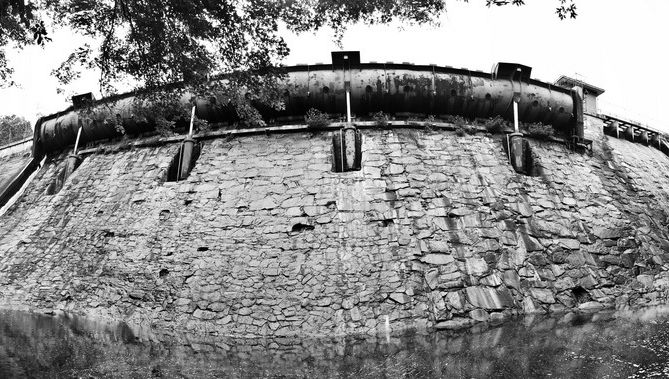
Here follows an excerpt from the 1970 Fairfax County Master Inventory of Historic Sites which contained entries from the Historic American Buildings Survey Inventory:
Lake Barcroft Dam:
Lake Barcroft Dam was erected on Holmes Run in 1915 for the Alexandria Water Company (organized 1850) by the Piedmont Construction Company. The contract for construction specified the "building of a Cyclopean masonry overflow concrete dam, with gatehouse, substructure and superstructure, concrete guide walls, and Cyclopean concrete core walls." Measuring approximately 400 feet in length and 75 feet in height, its storage capacity was reported as being 617,000,000 gallons of water in a 1939 bulletin published by the Department of Health of the Commonwealth of Virginia. In 1942, flood gates were installed to raise the spillway level and increase the capacity to 800,000,000 gallons of water. The rock was brought by a specially built railway from a quarry just east of Columbia Pike. Mr. E. C. Meredith, Director of the Division of Engineering of the Department of Health, stated in 1970 that Barcroft is probably the highest masonry dam in the state.
The Alexandria Water Company sold the facility to a group of developers from Massachusetts in 1950. Barcroft Beach, Incorporated maintains the dam and the community enjoys the use of the lake for water-oriented recreation and the amenities which derive from a residential community designed around a body of water.
Lake Barcroft was named after the Barcroft family which settled in the area in the mid 1800's and operated mills nearby. The ruins of one Barcroft mill are located just south of Columbia Pike on the east bank of Holmes Run.
<•>•<•>•<•>•<•>•<•>•<•>•<•>•<•>
<•>•<•>•<•>•<•>•<•>•<•>•<•>•<•>
Here follows an excerpt from the Lake Barcroft Association website:
Lake Barcroft came into being in 1915. An increasing need for water by the City of Alexandria led the Alexandria Water Company to build the dam and establish a reservoir to store the waters from the branches of Holmes Run. The North Branch of Holmes Run is now called Tripps Run.
Dam construction was begun in 1913 under contract with the Piedmont Construction Company. Specifications for the Barcroft Dam were severe and the construction was massive. The structure is of cyclopean masonry and concrete. The foundation is laid upon bed rock. A railway was built to transport the masonry stones to the dam site. The contractor went broke completing the job.
The result was a dam 400 feet wide with the spillway at the top 205 feet above mean sea level and 63 feet above the stream bed. Behind this dam there formed a lake of 115 acres and over five miles of shoreline. When full it held nearly 620,000,000 gallons and had an average daily runoff of about 10,000,000 gallons. In 1942 gates were installed at the top of the dam to raise the spillway level five feet. This increased the size of the reservoir to 135 acres and the capacity to about 800,000,000 gallons.
In the late 1940's the reservoir became too small to serve Alexandria and other water sources replaced its use. In 1950 the reservoir and its surrounding land were put up for sale by the Water Company. There was a movement to turn it into a Fairfax County park,but the Board of Supervisors considered the economics and decided in favor of private development. A partnership of developers from Boston bought the lake and 680 acres of land in the spring of 1950 for about one million dollars.
The principals in this venture were Joseph V. Barger and Charles E. Dockser whose association had resulted in several preceding real estate developments. Homesite sales began in the summer of 1950, and by early fall the bulldozers moved in to begin the community construction. Early in 1951 a 60-acre Malbrook tract was added to the Lake Barcroft area. In the time that followed the 750 acres were divided into 1,020 lots on which now stand 1,000 homes.
The honor of being first residents at Lake Barcroft is shared by the families of Dana Messer, at 3703 Tollgate Terrace, and Robert Oshins, at 3620 Stanford Circle. They built at the same time and it seems that the Messers moved in, in a tent, while their house was being completed, the Oshins being the first to occupy their permanent structure. Thus the title of "First resident" depends on definition, but both share the claim to being Barcroft's pioneers.
The relationship between the Lake Barcroft property owners and the lake as a community recreational facility was provided by the Barger-Dockser owned management corporation, Barcroft Beach, Inc., which retained title to the lake, the dam and the beaches. In return for an annual fee paid to this corporation, as a condition specified in his deed, each property owner was granted permission to use the lake and the beaches. Although the community members had exclusive use of the lake, through payment of their fees, they did not own it. Joseph Barger was the original and only Managing Director of Barcroft Beach, Inc. to the time of his death, and the residents used the lake under his terms and rules. From time-to-time uncompleted proposals occurred for the Lake Barcroft residents to buy the lake for themselves, an idea that has persistent presence since the first moments of the community.
In November 1969 Joseph Barger and Charles Dockser died within two days of each other. The heirs to their estates immediately announced intent to sell Barcroft Beach, Inc., and with it, of course, the lake, dam and beaches. To prevent possible outside acquisition and commercial use of the lake, the community joined in the creation of the Barcroft Lake Management Association, a non-stock, non-profit organization which acquired Barcroft Beach, Inc., and thus control of the lake. Initially, 725 members joined at $300 per membership. Since that time, the membership figure has risen as non-member households have joined. There were 992 in July 1998.
The Management Association, under the acronym "BARLAMA", undertook revitalization of the management, maintenance, and operation of the lake and was well into its 2nd season when, on June 21, 1972, a low-grade tropical storm heavy with rain, dubbed "Agnes" by the Weather Bureau, dumped the heaviest rainstorm of the century -- a 125 year downpour -- on the mid-Atlantic seaboard and washed out the earth at the west side of the dam, nearly emptying the lake in a matter of hours. The threat of permanent loss of the lake inspired immediate coalescence of community leadership, joining in the task of solving the problem of restoration and with unprecedented community support. The success of this enterprise and the creation of the Watershed Improvement District.
BARLAMA and the Lake Barcroft Community Association (LABARCA) merged in 1992. The organization is now called Lake Barcroft Association, Inc. (LBA).
Adapted from "Lake Barcroft Origins" by Will Fazar, Lake Barcroft Directory 1967, and "Some Virginia History" by Rex Lauck, Lake Barcroft Directory 1970. Revised, 1974 & 1979, by Myron Birnbaum. Revised, 1992 by William Lowenthal.