Innisfail Farm Stone House
GPS Coordinates: 38.7987811, -77.3546872
Closest Address: 11800 Fairfax Station Road, Fairfax Station, VA 22039
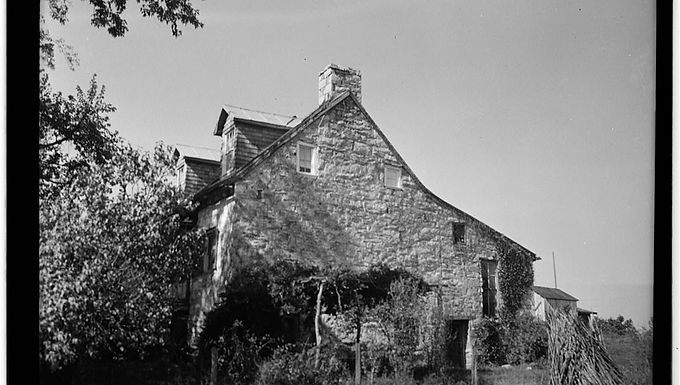
EDITOR'S NOTE: Innisfail Farm was established in 1771. It has a farm stand May-October.
<•>•<•>•<•>•<•>•<•>•<•>•<•>•<•>
<•>•<•>•<•>•<•>•<•>•<•>•<•>•<•>
Here follows an excerpt from the 1970 Fairfax County Master Inventory of Historic Sites which contained entries from the Historic American Buildings Survey Inventory:
Innisfail:
Located on what was once the Hope Park estate, this stone house was once the home of George Deneale. He was the first Fairfax County Court Clerk after the new courthouse was built in Providence (now Fairfax City) in 1800.
The foundations are 40 inches thick below and 28 inches at ground level. There is a large fireplace at either end of the living room, the oldest existing portion of the structure. The Gordons took down a central partition after they purchased the residence in 1935, thus making one large living room where there had been two smaller rooms. The west end of the room is paneled around a central fireplace, with glass-doored cupboards above and wooden-doored cupboards below the mantel line. There is a wooden chair rail around the entire room. Random width flooring is still in existence in the oldest section of the building. When excavating for an addition in 1941, the present owner, Paul Gordon, found an old foundation, which they utilized in the foundation of the new wing. Several openings for doors and windows have been altered over the years.
There are two stones in the woods near the house marking the graves of Lt. Robert Ions and his wife, who bought the estate sometime after 1852. (The family name was originally Jones.) The Ions' son, Robert, was one of the country's first licensed mail pilots, according to local residents.
The first Hope Park Mill was close to this house, on Pope's Head Creek near the Southern Railway, formerly the Orange and Alexandria Railroad. The Hope Park estate was owned in the 1700's by Edward Payne and later by Dr. David Stuart, one of the first three commissioners of the District of Columbia.
Innisfail is adjacent to land to be acquired for the new county general aviation airport expected to open in 1971.
<•>•<•>•<•>•<•>•<•>•<•>•<•>•<•>
<•>•<•>•<•>•<•>•<•>•<•>•<•>•<•>
Here follows an excerpt from the Fairfax Genealogical Society website:
A three-foot marble cross and two footstones stand in the woods beneath an old oak tree measuring four feet in diameter behind the house at 5943 Innisvale Road in the Oakbrook area of Fairfax Station. The cemetery is located on land which was once Hope Park Estate, according to a 1969 Historic American Buildings Survey, and the old house, originally the home of George Deneale, still stands at 11800 Fairfax Station Road. Robert Iones bought the estate sometime after 1852, according to the survey, and its name became Innisvale.
<•>•<•>•<•>•<•>•<•>•<•>•<•>•<•>
<•>•<•>•<•>•<•>•<•>•<•>•<•>•<•>
Here follows an excerpt from local author and historian Mary B. Lipsey's "This Old House: Annandale, Springfield, Burke & Beyond" presentation:
The Innisfail house was built by the Deneale family around 1770. They were Irish. He was the first county clerk of the court. Its not far from the Fairfax Station Railroad Museum on Fairfax Station Road. How did I get involved with this? Because I am into cemetery preservation and I went to a family cemetery behind somebody'd house not very far from here and it was the Ions family. And I asked a friend of mine who grew up here if they knew the Ions family. He said that what you are looking at it the generation before who I knew, because I knew Robin Ions who lived in the area during the 1920's.
And he said, "Did you know a man who flew a plane from his property in 1908?" That was Doctor William Christmas. When you get on a plane and you see these things on the end of the wings that go up and down , those are ailerons. He has the patent for this device. Robert Iones actually helped build the planes, and when there was a debate of who was getting the patent for the ailerons, they actually went out to the farm hands and an old farm hand showed a piece of metal that had been in the barn for 30 years twisted just like the ailerons, to show that Robert Iones actually invented the ailerons.
William Whitney Christmas, who claimed to have invented the aileron in the 1914 patent for what would become the Christmas Bullet which was built in 1918. Both "Bullet" prototypes crashed during their first "flights" when their wings broke off in flight due to flutter as a result of being deliberately unbraced. He is rightfully criticized for all the other things he did.